
This fresh milled sourdough bread is soft, mild, and perfect for everyday use. Made with spelt, rye, and hard white wheat, it’s a nourishing loaf that fits easily into a busy schedule with an overnight proof.
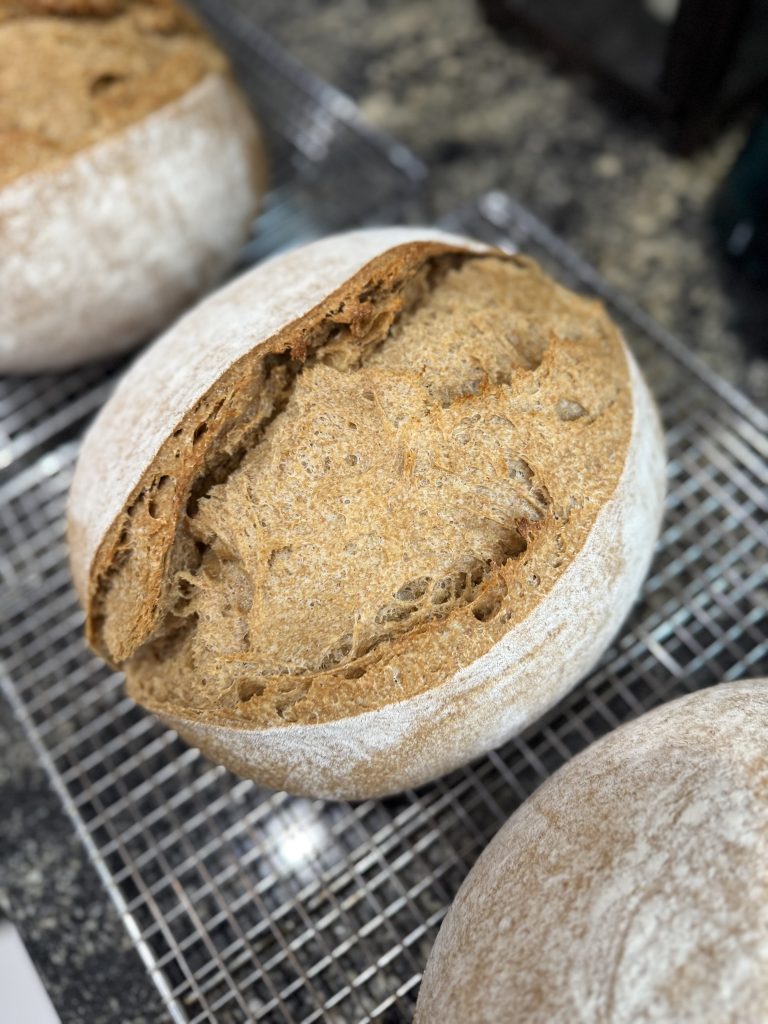
This particular bread has become a Scott Flock favorite because of its softness and mild flavor. It is also the bread I bring most often when sharing a meal with others. It includes the freshly milled ancient grains spelt and rye, in addition to the modern variety hard white wheat. I love that this loaf combines freshly milled ancient grains with modern wheat to create a bread that is both flavorful and very approachable.
In this post...
Equipment You Will Need:
- Grain Mill
- Stand Mixer
- Proofing Basket of some kind lined with a kitchen towel
- Dutch Oven
- Parchment Paper
- Razor or Knife for scoring
Ingredients You Will Need:
- 100g Fresh Milled Rye
- 200g Fresh Milled Spelt
- 200g Fresh Milled Hard White Wheat
- 400g Water
- 50g Olive Oil
- 25g Sucanat (or Cane Sugar)
- 25-50g Active Sourdough Starter (see notes below in step 3 about the amount to use and why)
- 12g of salt
My Process:
Step 1 – Mix the Dough
I usually start this process before going to bed because I plan to proof my dough overnight. Start with doing what I call a “rough mix.” I place my mixing bowl on a kitchen scale and weigh the ingredients in this order: water, starter, salt, olive oil, sucanat, and finally the freshly milled flour. Place your bowl on the stand mixer and using either the hook or a flat mixing paddle, mix at the slowest speed until all the ingredients are combined with no dry spots. Allow this mixture to rest for a minimum of 10 minutes, up to an hour.
Step 2 – Knead the Dough
Using your dough hook, begin the kneading process at a medium-low speed. You will see your dough go through three distinct phases. At first it will pull together quite nicely and you might be tempted to think you’re almost done already. Don’t be deceived; your dough has more development to do! In the second stage, your dough will begin to stick to the bottom and it will stay this way for several minutes. Trust the process and keep kneading. The third stage begins when your dough begins to look smoother and starts to lift up off the bottom of the bowl.
The third stage is complete when your dough is smooth in appearance, is no longer sticking to the bowl, and has built up a lot of tension. For me, this whole process typically takes about 9-10 minutes max. If you’re getting close to 8-9 minutes and your dough is showing no signs of building up some tension and is very slack to the touch (reach in and grab it with wet hands to test this out), you may want to consider adding some flour. Do this about 1/4 cup at a time.
Step 3 – Overnight Bulk Fermentation
I discovered over this past year that I could drastically reduce the amount of starter I was using and proof my dough overnight, so that I could just attend to it first thing in the morning. Starting bread before bed and baking in the morning fit much better with my schedule than what I had been doing before. When temperatures are warmer (our kitchen hangs around 75-76 degrees in summer) I needed only 25g of active sourdough starter for one loaf of bread. When temperatures were cooler (our kitchen is about 67-68 in winter) I needed 50g per loaf to get a decent rise by morning. Having a thermometer is your kitchen can be helpful, but you can also just go by how things feel. Summer means less starter and Winter means more. You’ll learn what works best in your own kitchen. Bulk ferment until DOUBLED.
Step 4 -Shape your Dough
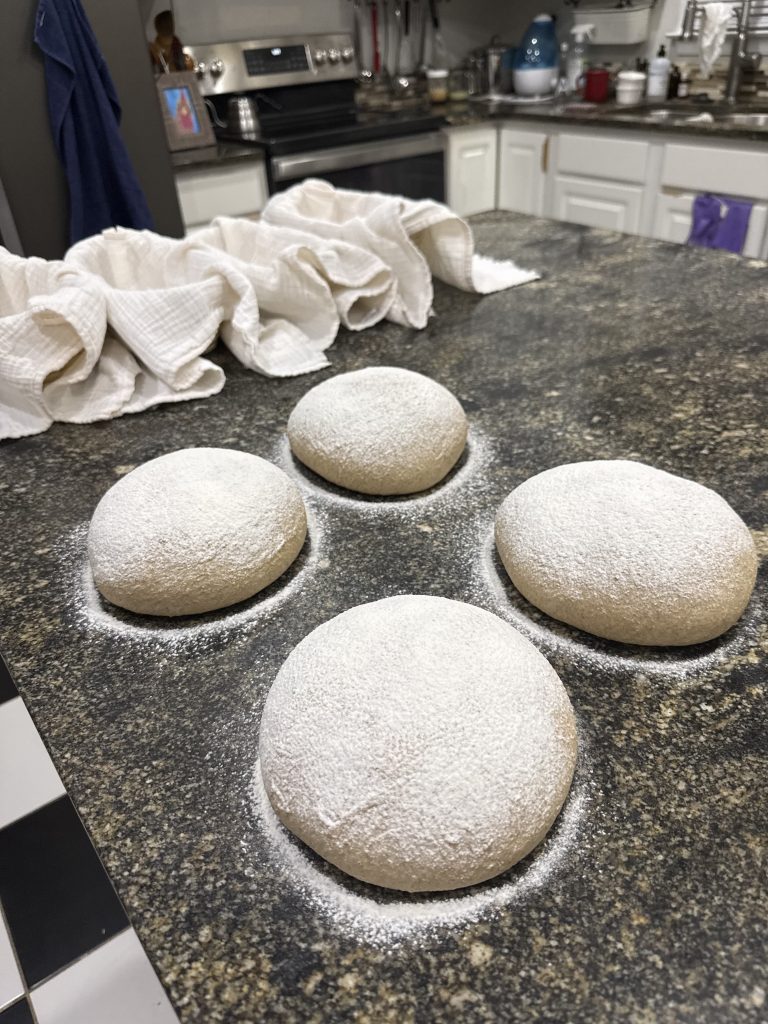
There are about 1 million videos on youtube on how to shape your sourdough bread and ultimately you will find what works for you. I personally start by wetting my left hand from a bowl of water, grabbing the dough on one side with one hand, lifting it up in the air a bit, and sort of slapping it down and folding it over itself. Repeat this process a couple of times until the dough has a bit of tension in it and is roundish in shape.
I then take my dough scraper and shape it into a tension roll on the counter. After sprinkling and rubbing some flour on top of the dough to keep it from sticking to my proofing container, I use my dough scraper to push the dough into a oval like shape, lift it up, and plop it into a proofing basket that has been lined with a towel.
Step 5 – Final Proof
I do this two different ways. I proof my bread on the counter for 1.5 hours *or* place it in the fridge to proof for 3 hours. If the dough is very slack, proofing in the fridge is best. If the dough is more of a medium strength, I feel comfortable proofing it on the counter for 1.5 hours.
Step 6 – Bake
I have found 40 minutes is the minimum for preheating my dutch oven to get the results I want. I preheat my oven at 375 degrees. When the dough is ready to go in, I turn it out onto a piece of baking parchment paper and score right down the middle with a single sided razor. Nothing fancy most days. I place this loaf into my preheated dutch oven, put the lid back on, and then bake for approximately 40-45 minutes, or until an inserted instant read thermometer reads 200 degrees in the center.
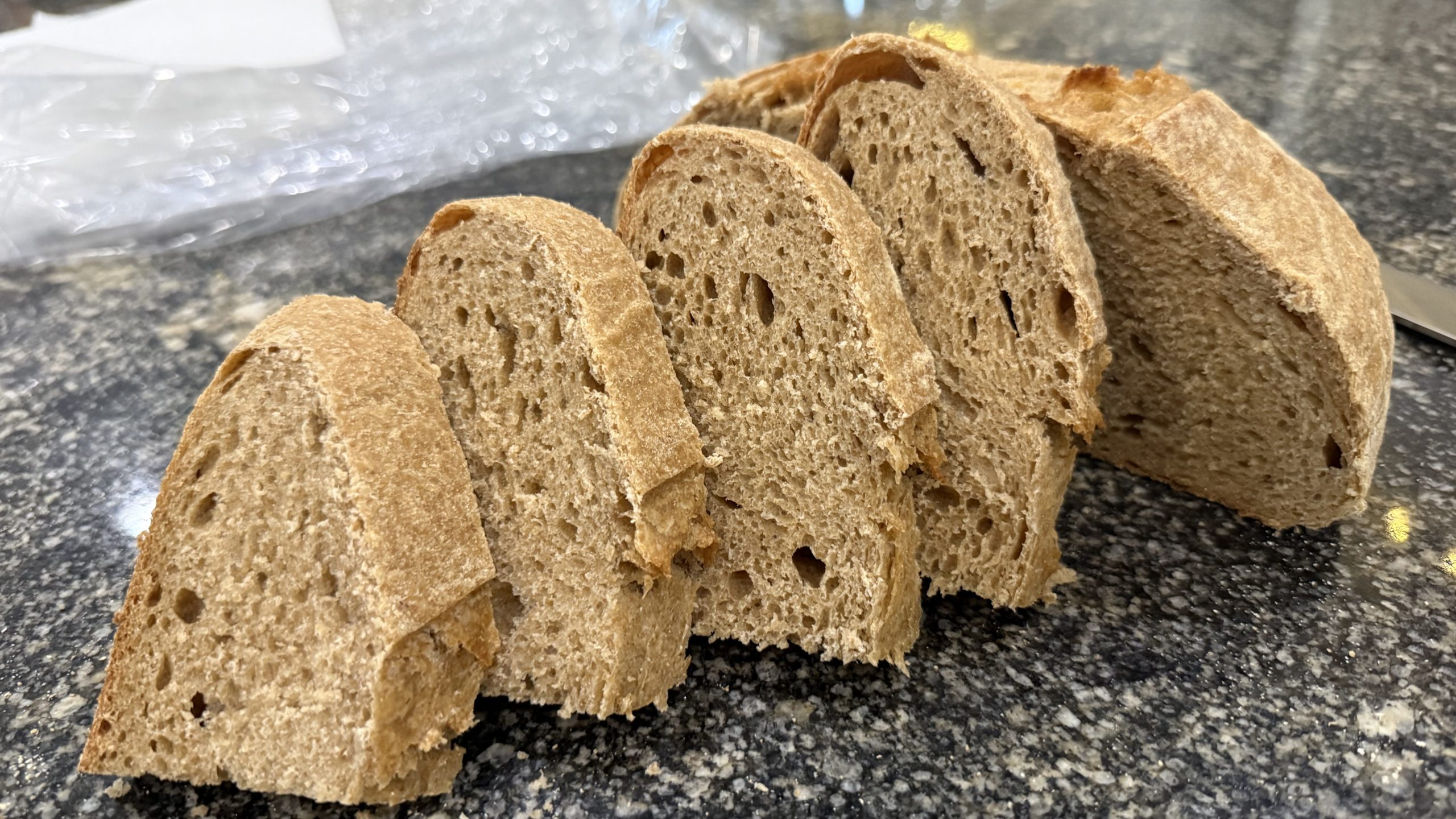
If you’re new to baking with freshly milled flour, don’t overthink it—just start. This is a forgiving, everyday loaf that fits into real life, and it only gets better as you learn what works in your own kitchen. This is the loaf I reach for when feeding both my family and friends, and I hope it serves your table just as well as it has mine.
Spelt & Rye Sandwich Bread

This fresh milled sourdough bread is soft, mild, and perfect for everyday use. Made with spelt, rye, and hard white wheat, it’s a nourishing loaf that fits easily into a busy schedule with an overnight proof.
Ingredients
- 100g Fresh Milled Rye
- 200g Fresh Milled Spelt
- 200g Fresh Milled Hard White Wheat
- 400g Water
- 50g Olive Oil
- 25g Sucanat (or Cane Sugar)
- 25-50g Active Sourdough Starter (see notes below in step 3 about the amount to use and why)
- 12g of salt
Instructions
- Mix Dough
Combine water, starter, salt, olive oil, and sucanat. Add flour and mix until no dry spots remain. Rest 10–60 minutes. - Knead
Knead on medium-low speed until smooth and elastic, about 8–10 minutes. Dough should release from the bowl and feel slightly tacky. - Bulk Fermentation (Overnight)
Cover and let dough rise on the counter overnight (8–12 hours). Use less starter in warm temps, more in cooler temps. - Shape
Shape into a round or oval loaf, creating surface tension. Place into a floured, towel-lined proofing basket. - Final Proof
Proof 1.5 hours at room temperature or 3 hours in the fridge, depending on dough strength. - Bake
Preheat oven and Dutch oven to 375°F for at least 40 minutes. Turn dough onto parchment, score, and bake covered 40–45 minutes, until internal temp reaches 200°F.
Instructions
Notes
Nutrition Information:
Yield:
20Serving Size:
50Amount Per Serving: Calories: 125Total Fat: 2.5gCarbohydrates: 18gFiber: 3gProtein: 4g

Hi! I’m Christina. I’m mama to 13 and grandma to two. With a toddler still underfoot, I’m in the thick of life just like you! My two top passions at the moment are baking with fresh milled flour and giving my children a positive homeschooling experience. Sprinkle in marriage, coffee, a small homestead, and life is overflowing! Learn more…
Leave a Reply